
Sourcing baby travel gearstrollers, car seats, tricycles, and related accessories is one of the most consequential decisions a brand owner or retailer can make. Unlike simpler consumer goods, baby products carry strict safety expectations, complex certification requirements, and a level of parental scrutiny that leaves little room for error. Choosing the wrong manufacturing partner doesn’t just cost money; it can damage a brand’s reputation before it even gets off the ground.
This guide walks through what actually matters when evaluating OEM and ODM partners for baby travel products, from certifications and materials to communication and long-term scalability.
Why Manufacturing Location Matters for Baby Travel Products
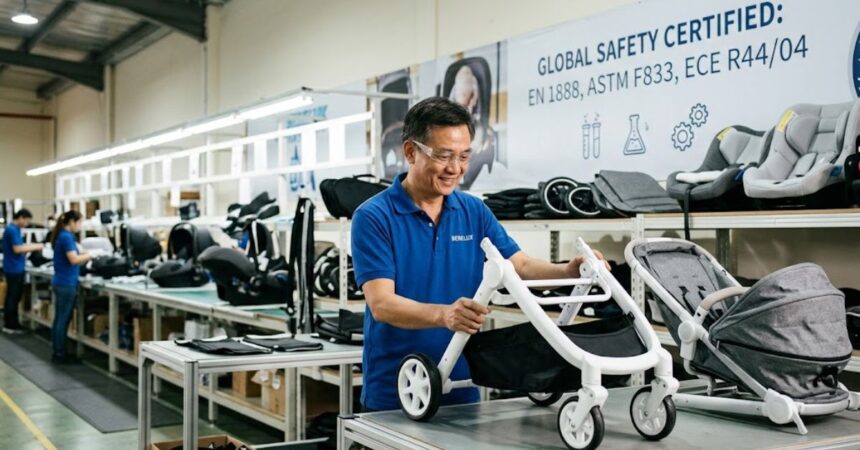
Most baby strollers, car seats, and tricycles sold globally today are produced in a handful of manufacturing hubs, with a significant concentration of expertise, component supply chains, and factory infrastructure built specifically around juvenile products. This concentration isn’t accidental; it reflects decades of specialization in metal tubing, wheel assemblies, fabric treatment, folding mechanisms, and safety hardware that baby travel gear depends on.
For brands evaluating suppliers, working with an established China baby stroller manufacturer often means access to mature supply chains, engineers who understand juvenile product regulations across multiple markets, and factories equipped to handle everything from small pilot runs to large-scale production. That said, not all manufacturers offer the same level of quality control or transparency, which is why due diligence matters as much as location.
Understanding the manufacturing landscape helps buyers ask better questions during supplier evaluation, rather than relying solely on price quotes or glossy product catalogs.
The Difference Between OEM and ODM
Before approaching any factory, it helps to understand the two primary manufacturing arrangements:
- OEM (Original Equipment Manufacturer): The factory produces your product based on your own design specifications, branding, and requirements. You own the intellectual property and design direction.
- ODM (Original Design Manufacturer): The factory offers an existing product design that you customize with your branding, color choices, and minor feature adjustments. This is often faster and cheaper for new brands testing the market.
Many buyers start with ODM to reduce upfront tooling costs, then transition to OEM once sales volume justifies custom molds and unique engineering.
Safety Certifications You Should Never Skip
Baby travel products are among the most heavily regulated consumer goods categories, and for good reason. A stroller’s braking mechanism, a car seat’s harness system, or a tricycle’s structural stability directly affects a child’s safety.
When evaluating a manufacturer, confirm which certifications their products already hold, and which ones they can support for your target markets:
Common International Standards
- EN 1888 – European safety standard for strollers and pushchairs
- ASTM F833 – US standard for carriages and strollers
- EN 1466 / EN 13209 – Standards covering carrycots and baby carriers
- FMVSS 213 – US federal standard for child car seats
- ECE R44/04 or R129 (i-Size) – European car seat safety regulations
- EN 71 – Toy safety standard, relevant for tricycles and ride-on toys
A reputable factory should be able to provide test reports from accredited third-party labs, not just self-issued documentation. If a supplier is vague about certification history or unwilling to share test reports, treat that as a warning sign rather than a minor detail to overlook.
Material Safety Testing
Beyond structural certifications, materials themselves need testing for:
- Lead and heavy metal content in paints and plastics
- Phthalate levels in soft plastics and teething-adjacent components
- Flame retardancy of fabrics
- Formaldehyde levels in foam padding
Ask suppliers for their material safety data sheets and recent batch testing results, especially if you’re importing into markets with strict consumer protection laws like the EU or California’s Proposition 65.
Evaluating Factory Capabilities Beyond Certifications
Certifications confirm a baseline, but they don’t tell you everything about whether a factory is the right long-term partner.
Production Capacity and Flexibility
Ask potential suppliers about their minimum order quantities (MOQs), typical lead times, and how they handle seasonal demand spikes. A factory that only accommodates large-volume orders may not suit a growing brand still validating product-market fit, while a factory too small may struggle once your orders scale.
Tooling and Customization Options
If you’re pursuing custom designs, ask about mold ownership, tooling costs, and how long it takes to develop new molds for frames, wheels, or folding hinges. Some factories offer semi-custom optionsswapping fabric, colors, or accessory kits on an existing frame which can significantly reduce development time and cost compared to a fully custom build.
Quality Control Processes
A serious manufacturer should have documented QC checkpoints at multiple stages:
- Incoming material inspection – checking raw materials and components before assembly
- In-line production checks – spot-checking during the manufacturing process
- Pre-shipment inspection – a final review of finished goods before they leave the factory
Ask whether you can arrange third-party inspections (through services like SGS, Bureau Veritas, or Intertek) before shipment. This is standard practice and any credible factory should welcome it rather than resist it.
Communication and Working Relationship
Technical capability means little if communication breaks down. Baby product development often involves multiple rounds of sample review, adjustments, and compliance documentation, so working with a team that responds clearly and promptly matters more than it might seem at first.
Questions Worth Asking Early
- Who will be your main point of contact, and what is their English proficiency and technical background?
- How are samples handled, cost, shipping time, and revision rounds?
- What is the standard payment structure (deposit, balance, payment terms)?
- Can they provide references from other international brands they’ve worked with?
A factory that answers these questions directly, with specifics rather than vague reassurances, is generally a better sign than one that rushes toward a deposit request.
Common Pitfalls When Sourcing Baby Travel Products
Even experienced buyers run into avoidable problems. A few recurring issues include:
Underestimating certification lead times. Testing and certification can take weeks or months depending on the standard and testing lab availability. Building this into your product timeline early prevents costly launch delays.
Skipping sample validation. Approving a design based on photos or renderings alone, without physically testing a sample stroller’s folding mechanism or a car seat’s harness adjustment, often leads to unpleasant surprises once bulk production begins.
Ignoring packaging and logistics details. Baby strollers and tricycles are bulky, and poor packaging design can lead to damage in transit or inflated shipping costs. Ask suppliers about their standard packaging dimensions and whether they offer flat-pack or reduced-volume options.
Overlooking after-sales support. Consider how the manufacturer handles defective batches, warranty claims, or spare parts requests after the initial order ships. This becomes especially important once your product is in the hands of end customers.
See More: How to Build a More Functional Home Office
Building a Long-Term Sourcing Strategy
For brands planning to grow beyond a single product line, it’s worth thinking about sourcing strategy holistically rather than negotiating each order in isolation.
Diversifying Within a Trusted Supplier Base
Rather than juggling entirely separate factories for strollers, car seats, and tricycles, some buyers consolidate with manufacturers who offer multiple product categories under one roof. This can simplify logistics, reduce the number of relationships to manage, and sometimes improve pricing through combined order volumes.
Planning for Market-Specific Compliance
If you intend to sell across multiple regions, say, both the EU and North America factor in that certification requirements differ. A stroller compliant with EN 1888 isn’t automatically compliant with ASTM F833. Clarify with your manufacturer early which certifications they already hold versus which would need to be pursued specifically for your target markets, since this affects both cost and timeline.
Investing in Sample Rounds
It’s tempting to move quickly from initial quote to bulk order, especially under tight launch deadlines. But investing time in multiple sample rounds testing fabric durability, wheel performance on different surfaces, and folding mechanism reliability over repeated use tends to pay off by catching design flaws before they become expensive to fix at scale.
Final Thoughts
Sourcing baby travel products is a process that rewards patience and diligence. The manufacturer you choose affects not just your production costs, but your certification pathway, your ability to scale, and ultimately how parents experience your product in daily use. Prioritizing factories with verifiable certifications, transparent quality control processes, and clear communication will save time and reduce risk far more than chasing the lowest quoted price.
Taking the time upfront to vet potential partners thoroughly asking for documentation, requesting samples, and understanding their production capabilities sets the foundation for a sourcing relationship that can support your brand as it grows from a first product line into a full catalog of baby travel essentials.
FAQs
Major stroller manufacturers (global brands):
Graco, Chicco, UPPAbaby, Bugaboo, Cybex, Britax, Baby Jogger, Maxi-Cosi, Stokke, Joie, and Thule.
Major baby product manufacturers in China:
Good baby International (owns Cybex, Evenflo, gb), Joie (owned by Goodbaby), Aprica’s manufacturing partners, Lorelli, and numerous OEM/ODM factories in Zhejiang and Jiangsu provinces that produce for both Chinese and international brands (including many of the private-label and white-label suppliers used by Western retailers).
Which brand is “best”:
There’s no single best — it depends on your needs:
- UPPAbaby / Bugaboo – premium build quality, urban design
- Cybex – strong safety ratings, travel-system compatibility
- Graco / Chicco – reliable, budget-friendly, widely available parts/accessories
- Baby Jogger – best for jogging/all-terrain use
Is Cybex a Chinese company?
Not originally — Cybex was founded in Germany. However, it’s now owned by Goodbaby International, a Chinese company headquartered in Hong Kong/mainland China, which acquired Cybex in 2013. So Cybex operates as a German-designed brand under Chinese corporate ownership, with much of its manufacturing tied into Goodbaby’s supply chain.