

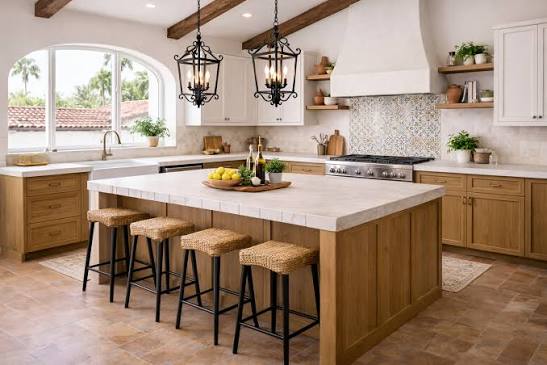
Choosing the right kitchen countertop material is an important part of designing or renovating a kitchen. Countertops have to handle food preparation, spills, heat, cleaning, appliances, and everyday wear while also contributing to the overall appearance of the room.
There are many countertop materials available today, including quartz, granite, marble, quartzite, laminate, solid surface, butcher block, and porcelain. Each option has different advantages and disadvantages when it comes to durability, maintenance, appearance, cost, and installation.
According to current countertop guides from Lowe’s and The Home Depot, the right choice depends on factors such as how the kitchen is used, the desired appearance, maintenance requirements, and budget.
What to Consider Before Choosing a Countertop
Before selecting a countertop, think about how you actually use your kitchen.
If you cook frequently, durability and resistance to stains, scratches, and heat may be more important than price. If the kitchen receives lighter use, an affordable material may provide everything you need.
Maintenance is another important consideration. Some natural stones require periodic sealing, while nonporous materials such as quartz generally require less maintenance.
You should also consider the style of your cabinets, flooring, backsplash, appliances, and kitchen lighting. A countertop should complement these elements rather than compete with them.
1. Quartz Countertops
Quartz is one of the most popular modern countertop materials. Unlike natural stone slabs, quartz countertops are engineered from crushed quartz combined with resin and other materials.
They are available in many colors and patterns, including designs that imitate marble and other natural stones.
Pros of Quartz Countertops
One of the biggest advantages of quartz is its low-maintenance surface. It is nonporous, which makes it resistant to many stains and means it does not require routine sealing like some natural stones.
Quartz also offers consistent colors and patterns, making it easier to coordinate multiple pieces in a kitchen.
It is a durable option for busy kitchens and is generally easy to clean with appropriate household products.
Cons of Quartz Countertops
Quartz can be relatively expensive compared with budget countertop materials.
Another important consideration is heat. The resin used in engineered quartz can be damaged or discolored by excessive heat, so hot pots and pans should not be placed directly on the surface.
Some homeowners may also prefer the completely natural variation of stone rather than the more uniform appearance of engineered quartz.
2. Granite Countertops
Granite is a natural stone that has been used in kitchens for many years.
Every granite slab has its own natural patterns, colors, and variations, making each countertop somewhat unique. Granite is also known for its durability and resistance to heat and scratches.
Pros of Granite Countertops
Granite provides a natural, high-end appearance and is available in many colors and patterns.
It can withstand considerable everyday kitchen use and is generally resistant to heat and scratching.
When properly sealed, granite can also resist stains and bacteria.
Cons of Granite Countertops
Granite is heavy, which means cabinets must be capable of supporting the countertop properly.
Because it is a natural stone, individual slabs can vary significantly. This is attractive to some homeowners but may make it difficult to achieve a perfectly uniform appearance.
Granite may also require periodic sealing to maintain stain resistance. Some slabs can chip or crack, and repairs or matching replacement pieces can be difficult.
3. Marble Countertops
Marble is often chosen for its elegant appearance and distinctive veining.
Its cool surface has also made it popular with people who bake and work with pastry. White marble can create a particularly luxurious appearance in both traditional and modern kitchens.
Pros of Marble Countertops
Marble has a timeless natural appearance that can become a major design feature.
Its veining makes every slab unique, and its cool surface can be useful for certain baking tasks.
Marble can also work beautifully with modern cabinets, traditional cabinetry, and minimalist kitchen designs.
Cons of Marble Countertops
Marble is porous and generally requires sealing and ongoing care.
It is also vulnerable to etching from acidic substances. Common kitchen ingredients such as lemon juice and wine can affect the surface if spills are not properly managed.
Marble is also softer than some other countertop stones, so scratches and surface marks may occur with everyday use.
For homeowners who want a low-maintenance countertop, marble may require more care than engineered alternatives.
4. Quartzite Countertops
Quartzite is a natural stone that is sometimes confused with engineered quartz because of the similar names.
Natural quartzite forms from sandstone that has undergone metamorphism. It is known for its strength and can provide a natural stone appearance similar to marble.
Pros of Quartzite Countertops
Quartzite is highly durable and can provide strong resistance to heat, scratching, and many kitchen acids.
It can also offer the natural veining and variation that people appreciate in stone countertops.
For homeowners who want a natural material with a sophisticated appearance, quartzite can be an attractive choice.
Cons of Quartzite Countertops
Quartzite generally requires sealing to improve resistance to staining.
Natural slabs can vary considerably in appearance, and some varieties can be expensive.
It is also important to confirm that the material is genuine quartzite rather than another stone being marketed under a similar appearance.
5. Laminate Countertops
Laminate is one of the most budget-friendly countertop choices.
Modern laminate is available in a wide range of colors, patterns, and finishes. Some products are designed to imitate granite, marble, wood, and other materials.
Pros of Laminate Countertops
The biggest advantage is affordability.
Laminate is also lightweight, relatively easy to install, and simple to clean. Its wide variety of designs makes it possible to achieve different kitchen styles without the cost of natural stone.
For a budget kitchen renovation, laminate can provide a practical balance between appearance and price.
Cons of Laminate Countertops
Laminate generally does not have the same durability as high-end stone surfaces.
It can be scratched, and excessive heat can damage the surface. Seams may also be visible depending on the design and installation.
Water can become a concern if it reaches vulnerable edges or damaged areas, so spills should be cleaned promptly.
6. Solid Surface Countertops
Solid surface countertops are manufactured materials commonly made from acrylic or similar compounds.
They are available in many colors and can provide a clean, seamless appearance. Some designs imitate natural stone.
Pros of Solid Surface Countertops
One major advantage is the ability to create seams that are nearly invisible.
Solid surface is also nonporous and relatively easy to clean. Light surface damage can sometimes be sanded and refinished, giving the material an advantage over some surfaces that cannot be repaired as easily.
It is available in many colors and styles.
Cons of Solid Surface Countertops
Solid surface is generally less resistant to high heat and deep scratches than some stone materials.
It can also be more vulnerable to damage from sharp objects and very hot cookware.
Although repairs are possible in some situations, significant damage may still require professional attention.
7. Butcher Block Countertops
Butcher block brings the warmth and natural appearance of wood into the kitchen.
It can be made from different types of wood and is often used on islands, breakfast areas, and sections of countertop.
Pros of Butcher Block Countertops
Wood provides a warm and inviting appearance that works particularly well in farmhouse, rustic, traditional, and even contemporary kitchens.
One advantage is that scratches and minor damage can often be sanded and repaired.
Butcher block can also be more affordable than some natural stone options, depending on the wood species and construction.
Cons of Butcher Block Countertops
Wood requires more maintenance than many nonporous countertop materials.
Depending on the finish, butcher block may require regular oiling or sealing to protect it from moisture and drying.
It can also be affected by excessive heat, water, scratches, and changes in humidity.
For homeowners who prefer a countertop that requires very little maintenance, butcher block may not be the easiest option.
8. Porcelain Countertops
Porcelain is another material used for modern kitchen countertops.
It can be manufactured in large slabs and is available in a variety of colors and patterns. Some porcelain products are designed to reproduce the appearance of natural stone.
Pros of Porcelain Countertops
Porcelain can provide a contemporary appearance and can work well with modern kitchen designs.
It is also known for its resistance to heat, staining, and many everyday kitchen conditions.
Large porcelain slabs can create a relatively continuous appearance with fewer visible joints.
Cons of Porcelain Countertops
Porcelain can be more complicated to fabricate and install than some other materials.
The edges can also be vulnerable to chipping if handled or installed incorrectly.
Because large slabs can be heavy and difficult to work with, professional fabrication and installation may be preferable.
Countertop Material Comparison
| Material | Main Advantage | Main Disadvantage | Maintenance |
|---|---|---|---|
| Quartz | Low maintenance and durable | Heat can damage resin | Low |
| Granite | Natural beauty and heat resistance | May require sealing | Moderate |
| Marble | Elegant appearance | Can etch and stain | High |
| Quartzite | Natural strength and appearance | Usually requires sealing | Moderate |
| Laminate | Affordable | Less resistant to heat and scratches | Low |
| Solid Surface | Seamless appearance | Less heat resistant | Low to moderate |
| Butcher Block | Warm natural appearance | Requires regular care | Moderate to high |
| Porcelain | Heat and stain resistance | Installation can be challenging | Low |
The exact performance and maintenance requirements can vary by product, finish, manufacturer, and installation method.
Quartz vs. Granite
Quartz and granite are often compared because both are popular choices for homeowners looking for durable countertops.
Quartz provides a more consistent appearance and is nonporous, while granite offers natural variation because each slab is formed from natural stone.
Granite can tolerate high temperatures well, while quartz requires more caution around hot cookware because of its resin content.
The choice between them often comes down to whether you prefer the consistency and low maintenance of engineered quartz or the natural variation of granite.
Marble vs. Quartz
Marble and quartz can both provide an elegant appearance, particularly when using white or light-colored designs.
Marble offers natural veining and a genuine stone surface, while quartz can reproduce marble-like patterns with more consistent coloration.
Quartz is generally easier to maintain because it is nonporous, whereas marble needs sealing and greater care around acidic foods.
If you love natural stone and accept the maintenance, marble can be appealing. If low maintenance is a priority, quartz may better fit your requirements.
Laminate vs. Butcher Block
Laminate and butcher block can both be attractive choices for homeowners working with a limited budget.
Laminate provides a huge variety of colors and patterns and generally requires little maintenance.
Butcher block provides genuine wood character and can be repaired by sanding in many cases, but it requires more attention to moisture and finish.
Your choice will depend on whether you prioritize easy maintenance or the natural warmth of wood.
What Is the Most Affordable Countertop Material?
Laminate is generally among the most affordable countertop options. Current Lowe’s guidance identifies laminate as its most affordable countertop type, while The Home Depot similarly describes laminate as the most affordable option in its countertop guide.
However, the final project cost depends on countertop size, edge treatments, cutouts, installation, material quality, and local labor prices.
What Is the Easiest Countertop to Maintain?
Nonporous materials such as quartz and many solid-surface countertops are generally easy to maintain.
Quartz does not require routine sealing, while solid surface can be cleaned with ordinary care and may be refinished if lightly damaged.
Laminate is also relatively easy to clean, although it requires more caution around excessive heat and damaged edges.
What Is the Most Durable Countertop?
There is no single material that is ideal for every type of kitchen use.
Quartz is widely regarded as a highly durable, low-maintenance option, while granite and quartzite are strong natural stone choices. The specific product and how it is used also matter.
For example, heat resistance may matter more to someone who frequently cooks with hot pans, while stain resistance may be more important to a household with young children.
How Much Should You Spend on a Countertop?
There is no universal budget because countertop prices vary significantly by material, location, fabrication, installation, edge profile, and project size.
Laminate is generally positioned toward the budget end, while natural stone and premium engineered materials can cost substantially more.
Rather than choosing solely based on the price per square foot, consider the complete installed cost. Cutouts for sinks and cooktops, edge profiles, seams, delivery, and installation can all affect the final price.
How to Choose the Right Countertop Material
Start by identifying your priorities.
If low maintenance is important, consider nonporous options such as quartz or solid surface. If natural beauty is your priority, granite, marble, or quartzite may be worth considering.
For a lower-cost renovation, laminate can be practical. If you want warmth and natural character, butcher block may be a good fit.
Also consider the way you cook. A household that regularly places hot cookware on the countertop needs a different material strategy from a household that mainly uses the surface for light food preparation.
Think About the Kitchen’s Overall Style
Countertops occupy a large visual area, so they should work with the rest of the kitchen.
For a modern kitchen, simple quartz, porcelain, or solid-surface designs can create a clean appearance.
Traditional kitchens can work well with granite or marble, while butcher block can add warmth to farmhouse and transitional designs.
Do not choose a countertop in isolation. Look at cabinet samples, flooring, backsplash materials, wall colors, and lighting together before making the final decision.
Always Request Samples
A countertop can look very different under different lighting conditions.
Before ordering, obtain samples or visit a showroom to view the material in person. Place the sample beside your cabinet, flooring, backsplash, and wall colors.
This can help you identify differences in undertones that may not be obvious in online photographs.
For natural stone, viewing the actual slab can be particularly valuable because patterns and colors can vary from one piece to another.
Think About Maintenance Before Buying
Every countertop needs some level of care, but the amount varies considerably.
Ask how often the material needs sealing, which cleaning products are appropriate, how it responds to heat, and whether scratches or chips can be repaired.
For example, butcher block may need periodic oiling, while marble needs protection against stains and acid etching. Quartz generally requires less maintenance but still needs protection from excessive heat.
Understanding these requirements before purchase can prevent unpleasant surprises later.
Final Thoughts
The best kitchen countertop material depends on your budget, cooking habits, preferred appearance, and willingness to maintain the surface.
Quartz offers low maintenance and a wide range of designs. Granite provides natural variation and strong durability. Marble delivers distinctive elegance but requires more care. Quartzite offers a durable natural-stone alternative, while laminate provides affordability and design flexibility.
Butcher block adds warmth and can be repaired, but it needs regular attention. Solid surface provides a seamless appearance and easy maintenance, while porcelain offers another durable option for contemporary kitchens.
Instead of searching for one universally perfect material, focus on finding the countertop that fits the way you live and use your kitchen.
Frequently Asked Questions
1. What is the most popular kitchen countertop material?
Quartz is one of the most popular countertop choices because it combines durability, low maintenance, and a wide selection of colors and patterns. Current Lowe’s guidance also identifies quartz as a leading countertop option.
2. Is quartz better than granite?
Quartz and granite have different characteristics. Quartz is nonporous and generally requires less maintenance, while granite offers natural stone variation and strong heat resistance. The better choice depends on your priorities.
3. What is the cheapest kitchen countertop material?
Laminate is generally one of the most affordable countertop materials. Its low cost, wide range of designs, and relatively simple installation make it popular for budget renovations.
4. Which countertop requires the least maintenance?
Quartz and many solid-surface countertops are among the easiest to maintain because they are nonporous and generally do not require regular sealing.
5. Does quartz stain easily?
Quartz is nonporous and resistant to many stains, which makes it suitable for busy kitchens. However, spills should still be cleaned promptly, and manufacturer care instructions should be followed.
6. Can you put hot pans on quartz?
You should avoid placing very hot cookware directly on quartz. Excessive heat can damage or discolor the resin used in engineered quartz countertops. Use trivets or heat-resistant pads instead.
7. Does granite need to be sealed?
Many granite countertops benefit from sealing to improve resistance to stains and moisture. The required maintenance depends on the particular stone and sealer, so follow the fabricator’s recommendations.
8. Is marble a good material for kitchen countertops?
Marble can be an excellent choice for homeowners who appreciate its natural appearance and are willing to maintain it. However, marble is porous and susceptible to acid etching, so it requires more care than many engineered materials.
9. Is butcher block difficult to maintain?
Butcher block requires more maintenance than many stone alternatives. Depending on the finish, regular oiling or sealing may be necessary to protect the wood from moisture and drying.
10. Can laminate countertops look like stone?
Yes. Modern laminate is available in many patterns designed to resemble granite, marble, wood, and other materials. This allows homeowners to achieve different visual styles without paying for a natural stone surface.
11. Which countertop material is best for a busy kitchen?
A busy kitchen generally benefits from a surface that is durable, stain-resistant, and easy to maintain. Quartz is one option, while granite, quartzite, and solid surface may also suit different cooking and maintenance preferences.
12. Should I choose the countertop before the cabinets?
It is usually best to coordinate countertop and cabinet selections rather than choosing either completely independently. Cabinet color, countertop pattern, backsplash, flooring, and lighting should work together as part of the overall kitchen design.