

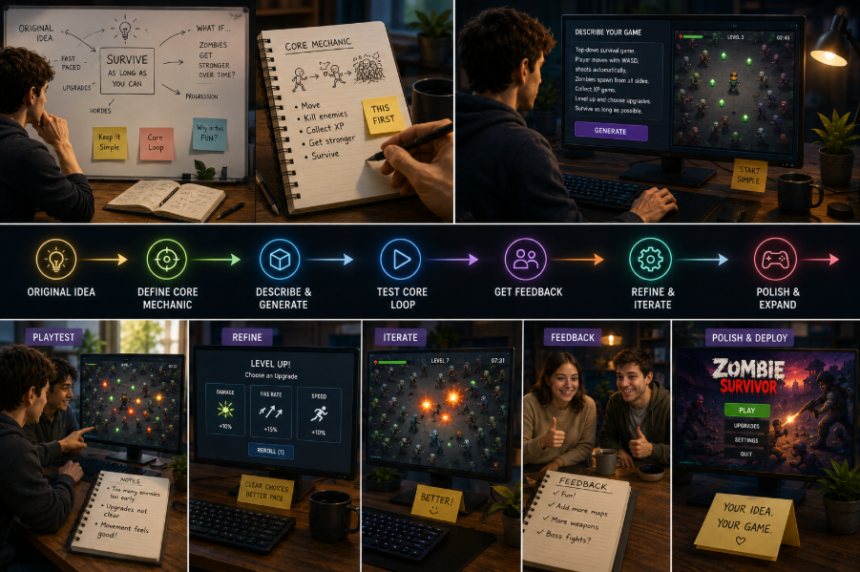
Most games people play today started as a single, undeveloped thought, a “what if” that could have easily stayed a passing idea instead of becoming something playable. The gap between having that thought and actually building it used to be enormous. It isn’t anymore, but turning an original idea into a real game still requires a clear process, not just enthusiasm and a vague concept.
Why Original Ideas Often Never Get Built
Most people who think of a genuinely interesting game concept never act on it, and it’s rarely because the idea was weak. It’s because the distance between “I have an idea” and “I have something playable” used to feel enormous, requiring technical skill that had nothing to do with the creative spark behind the concept in the first place. That gap quietly killed more good ideas than bad execution ever did.
Turning a Vague Idea Into Something Buildable
Get Specific About the Core Feeling
Every original idea starts vague, “a survival game,” “something with time travel,” “a puzzle game but different.” Before building anything, narrow that vague concept down to a specific feeling you want the player to experience. Tension, satisfaction, cleverness, chaos, whatever it is, naming it clearly gives every later design decision something concrete to serve.
Identify the One Mechanic That Carries the Idea
An original idea usually lives or dies on a single core mechanic, not a long list of features. Strip the concept down to that one action the player will do most often, and make sure it’s genuinely satisfying on its own, before adding anything else around it. If the core mechanic isn’t fun by itself, no amount of surrounding content will fix that.
Resist the Urge to Add Everything at Once
Original ideas tend to sprawl in a creator’s head, one good concept naturally suggests a dozen others. Write those extra ideas down, but build only the core one first. Trying to include everything from the start almost always dilutes the very thing that made the original idea interesting in the first place.
Moving From Concept to Playable Prototype
Describe the Idea Instead of Coding It
This is where the process looks completely different than it used to. Rather than learning to code the mechanic yourself, you can describe what you want to happen, the way the player moves, what they’re trying to do, what makes them fail or succeed, and see it translated into something playable almost immediately. This is genuinely how anyone can learn how to create a game from an idea they’ve never had the technical means to build before.
Test the Core Loop Before Anything Else
Once a rough version exists, the only question that matters at first is whether the core loop feels good. Not whether it looks finished, not whether it has enough content, just whether the single core action is satisfying to repeat. If it isn’t, no amount of added polish will save the concept.
Study How Similar Original Ideas Got Executed
Looking at how another game handled a comparable premise can clarify what’s working or missing in your own prototype. Zombie Survivor is a useful reference here, an original take on a familiar survival premise executed with a clear, well-tuned core loop that shows how a strong central mechanic can carry an entire game without needing excessive complexity layered on top.
Refining the Idea Through Real Feedback
Watch Someone Play It Without Explaining Anything
The fastest way to learn whether your original idea actually works is to hand it to someone else and say nothing. Where they get confused, where they lose interest, and where they naturally want to keep playing tells you more than your own instincts ever could at this stage.
Protect the Original Idea While Adjusting the Execution
Feedback will often suggest changes, but it’s worth distinguishing between feedback about execution and feedback that quietly asks you to abandon what made the idea original in the first place. Adjust pacing, difficulty, and clarity freely. Be more careful about diluting the specific creative spark that made the concept worth building.
Iterate in Small, Deliberate Steps
Change one thing at a time and retest, rather than overhauling several elements at once based on a single round of feedback. This keeps you from accidentally fixing one problem while breaking the exact thing that made the original idea interesting to begin with.
Common Mistakes When Building From an Original Idea
A frequent mistake is spending too long refining the idea in your head before ever testing a rough version, when a rough prototype almost always reveals more than further theorizing ever could. Another is treating the first version as the final version, and getting discouraged when it doesn’t yet capture the full vision, rather than recognizing that this is exactly what early iterations are supposed to look like. And some creators abandon a genuinely original idea too early simply because the first prototype felt rough, when the core concept just needed a few rounds of refinement to click.
Final Thoughts
Turning an original idea into a real game was never really about technical skill, even back when technical skill was the main obstacle standing in the way. It was always about clarity, knowing what feeling you’re chasing, what mechanic carries it, and having the patience to refine a rough version until it matches what you originally imagined. What’s changed is that the distance between having that idea and testing it has shrunk dramatically, which means the only real question left is whether you’re willing to build the idea you’ve already got.