

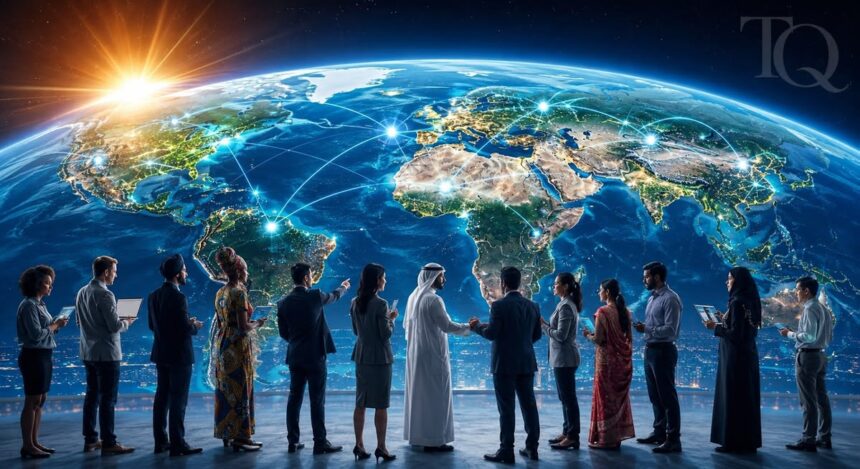
Globalization has become one of the most influential forces shaping modern society. It refers to the growing interconnectedness of countries, economies, communities, businesses, and individuals through trade, technology, communication, transportation, and cultural exchange. What once required weeks or months to accomplish can now happen within seconds because of digital communication and global networks.
From the products people purchase to the way businesses operate and individuals communicate, globalization has transformed everyday life. It has created new opportunities for economic development, education, employment, and cultural exchange while also introducing challenges involving inequality, employment, cultural identity, environmental sustainability, and social change.
Understanding how globalization affects modern society is therefore essential for recognizing both its benefits and its complexities.
What Is Globalization?
Globalization is the process through which societies and economies become increasingly connected across national borders. It involves the movement of goods, services, capital, information, technology, people, and ideas between countries.
International trade is one of the oldest forms of globalization, but modern globalization has expanded significantly because of the internet, smartphones, cloud computing, international transportation, and digital financial systems.
Today, a business in one country can sell products to customers thousands of miles away, while employees can collaborate with colleagues across several continents without leaving their homes.
The Role of Technology in Globalization
Technology has accelerated globalization more than almost any previous development. The internet allows people to communicate instantly regardless of geographical distance.
Social media platforms, video conferencing, messaging applications, and collaboration tools have created global communities where people can exchange information and ideas in real time.
Cloud computing has also allowed businesses to operate international teams and provide digital services to customers around the world. As artificial intelligence and automation continue to develop, technology is likely to make global connections even stronger.
Globalization and the Economy
One of the most significant effects of globalization can be seen in the global economy. Companies can manufacture products in one country, source materials from another, and sell their products to customers worldwide.
International trade creates opportunities for businesses to reach larger markets. It can also give consumers access to a wider variety of products at competitive prices.
For developing economies, globalization can attract foreign investment, encourage industrial development, create employment opportunities, and increase access to international markets.
However, economic globalization can also create challenges. Businesses may move operations to regions where production costs are lower, potentially affecting employment in higher-cost economies. Global competition can also place pressure on smaller businesses that lack the resources of multinational corporations.
Globalization and Employment
The modern workforce has become increasingly international. Companies can recruit employees based on skills rather than geographical location, particularly for jobs that can be performed remotely.
Outsourcing and international service centers have created employment opportunities in many developing economies. Technology professionals, customer-service workers, designers, financial specialists, and other professionals can serve international clients without physically relocating.
At the same time, globalization can increase competition for certain jobs. Workers may need to continuously develop new skills to remain competitive in changing labor markets.
The Growth of Remote Work
Globalization and digital technology have contributed to the growth of remote employment. A professional can work for a company headquartered in another country while living thousands of miles away.
This development has expanded access to international employment and allowed organizations to recruit talent from a much larger pool.
Remote work also creates new questions concerning taxation, employment regulations, working hours, cybersecurity, and cross-border payments. Businesses must adapt their policies to manage increasingly international workforces.
Globalization and Education
Education has become more internationally connected. Students can access online courses, digital libraries, international universities, educational videos, and research from around the world.
Online learning platforms allow people to develop professional skills without necessarily attending traditional institutions. International academic collaboration has also increased, enabling researchers and students to exchange knowledge across borders.
Globalization has therefore made educational resources more accessible, although differences in internet access and educational infrastructure continue to create a digital divide.
Cultural Exchange
Globalization has encouraged cultural exchange on an unprecedented scale. Music, films, food, fashion, literature, sports, and entertainment can travel rapidly across borders.
People can discover traditions and lifestyles from countries they may never physically visit. International cultural exchange can encourage greater understanding and appreciation of different communities.
However, cultural globalization can also create concerns about cultural homogenization. Local traditions and languages may face pressure when global cultural trends become dominant.
The Impact on Food and Lifestyle
Globalization has dramatically influenced eating habits and lifestyles. Foods that were once associated with particular regions are now available in cities across the world.
International restaurant chains operate across multiple continents, while social media has introduced people to recipes, diets, cooking styles, and lifestyle trends from different cultures.
This exchange has created greater variety but can also encourage the spread of unhealthy consumption patterns and highly processed foods.
Globalization and Communication
Communication has become faster and more accessible. People can maintain relationships with family members, friends, colleagues, and communities regardless of geographical distance.
Social media has created global conversations around entertainment, politics, business, education, environmental issues, and social movements.
However, rapid communication also creates challenges. Misinformation, online manipulation, privacy concerns, and cultural misunderstandings can spread across borders just as quickly as useful information.
Globalization and Consumer Behavior
Consumers now have access to products and services from international companies. Online marketplaces allow customers to purchase goods from businesses located in other countries.
This has increased competition and encouraged companies to improve product quality, pricing, customer service, and innovation.
Consumers also have greater access to reviews and information before making purchasing decisions. As a result, businesses must increasingly consider global customer expectations.
Globalization and Small Businesses
Globalization is not limited to large multinational corporations. Small businesses can also reach international customers through websites, social media, digital marketplaces, and online payment systems.
A small company can sell specialized products to customers around the world without establishing physical stores in every market.
Nevertheless, international expansion requires businesses to understand shipping, taxation, regulations, cultural differences, currencies, and customer expectations.
Globalization and Healthcare
Healthcare systems are also becoming increasingly interconnected. Medical researchers from different countries collaborate on research, clinical studies, treatments, and public health initiatives.
International cooperation can accelerate the development and distribution of medical knowledge.
Global health challenges have demonstrated the importance of cooperation between governments, researchers, healthcare organizations, and international institutions.
Environmental Consequences
Globalization has both positive and negative environmental effects.
International cooperation can support renewable energy development, environmental research, conservation initiatives, and climate policies.
However, increased manufacturing, international transportation, resource extraction, and consumption can contribute to pollution and greenhouse gas emissions.
Sustainable globalization therefore requires businesses and governments to balance economic development with environmental responsibility.
Globalization and Inequality
Globalization can create wealth and economic opportunities, but its benefits are not distributed equally.
Some countries and communities have benefited significantly from international trade and investment, while others have struggled to compete or gain access to global markets.
Within individual countries, highly skilled workers may benefit more from globalization than workers in industries affected by automation or international competition.
Reducing inequality requires investment in education, infrastructure, worker training, social protection, and inclusive economic policies.
Political Effects of Globalization
Globalization has increased cooperation between governments through international agreements, organizations, and institutions.
Countries must increasingly work together on issues such as climate change, cybersecurity, international trade, migration, financial stability, and public health.
At the same time, globalization can generate political debates concerning national sovereignty, immigration, trade policies, and economic dependence.
Globalization and Migration
People increasingly move between countries for employment, education, family, and other opportunities. Migration contributes to cultural diversity and can help countries address labor shortages.
Migrants often contribute skills, entrepreneurship, and economic activity to their destination countries.
However, migration can also create challenges related to housing, employment, public services, integration, and immigration policy.
The Digital Global Economy
The digital economy has made globalization more accessible to individuals and small businesses. Freelancing platforms, digital services, e-commerce, online education, and remote employment allow people to participate in international markets from almost anywhere.
Digital payments and cloud-based tools further reduce geographical barriers.
As digital infrastructure continues improving, the distinction between local and global business will become increasingly blurred.
The Importance of Global Skills
Modern workers increasingly need skills that allow them to operate in international environments. Communication, digital literacy, adaptability, cultural awareness, critical thinking, and foreign-language skills can be valuable in global workplaces.
Lifelong learning is becoming increasingly important because technological and economic changes can quickly alter job requirements.
How Globalization Is Changing Cities
Globalization has transformed many major cities into international business and cultural centers. Cities attract multinational companies, international students, tourists, skilled workers, and entrepreneurs.
This can stimulate economic growth and cultural diversity but may also increase housing costs, traffic congestion, inequality, and pressure on infrastructure.
Future urban planning will need to balance international economic activity with quality of life for local communities.
The Future of Globalization
Globalization is unlikely to disappear, but its structure will continue to evolve. Artificial intelligence, automation, renewable energy, digital commerce, remote work, and advanced transportation will influence how countries and businesses interact.
The future may involve greater digital globalization, where services and knowledge move across borders more easily than physical products.
At the same time, geopolitical tensions, supply-chain concerns, environmental challenges, and changing trade policies may encourage countries to strengthen domestic industries and diversify international partnerships.
How Society Can Adapt
Adapting to globalization requires individuals, businesses, governments, and educational institutions to remain flexible.
Education systems should prepare students for international and technology-driven workplaces. Businesses should develop resilient supply chains and invest in employees. Governments should create policies that encourage innovation while protecting workers and the environment.
Individuals can benefit by developing digital skills, learning about different cultures, improving communication abilities, and remaining open to lifelong learning.
Conclusion
Globalization has fundamentally changed modern society by connecting people, businesses, economies, and cultures more closely than ever before. It has expanded access to international markets, technology, education, employment, information, and cultural experiences.
However, globalization also presents challenges involving inequality, cultural preservation, environmental sustainability, employment disruption, and digital security. Its long-term success will depend on how effectively societies manage these challenges while making the most of global cooperation.
As technology continues to advance, globalization will remain an important force shaping the future. The societies best prepared for this changing environment will be those that combine innovation and international cooperation with sustainability, inclusion, education, and responsible development.
Frequently Asked Questions
What is globalization in simple terms?
Globalization is the increasing connection between countries, businesses, communities, and individuals through trade, technology, communication, transportation, and cultural exchange.
How has technology increased globalization?
The internet, smartphones, cloud computing, digital payments, social media, and video conferencing allow people and organizations to communicate and conduct business across borders almost instantly.
What are the main benefits of globalization?
Major benefits include greater international trade, access to new markets, technological exchange, educational opportunities, cultural exchange, employment opportunities, and wider consumer choice.
What are the disadvantages of globalization?
Potential disadvantages include economic inequality, job displacement, environmental pressures, cultural homogenization, increased competition, and dependence on international supply chains.
How does globalization affect businesses?
Globalization allows businesses to reach international customers, access global talent and suppliers, and expand into new markets. However, it also increases competition and requires companies to understand international regulations and consumer expectations.
Does globalization affect culture?
Yes. Globalization encourages cultural exchange by making international music, food, entertainment, fashion, and ideas more accessible. It can also create concerns about the preservation of local cultures and languages.
How does globalization affect education?
Students can access international research, online courses, educational resources, and academic collaboration. Digital education has made knowledge more accessible, although unequal internet access remains a challenge.
Is globalization good or bad for society?
Globalization has both advantages and disadvantages. Its effects depend on how economic, social, technological, and environmental challenges are managed.
What is the future of globalization?
The future of globalization will likely be increasingly digital, driven by artificial intelligence, remote work, e-commerce, cloud computing, international collaboration, and advanced communication technologies.
How can individuals benefit from globalization?
Individuals can benefit by developing digital and professional skills, learning about different cultures, accessing international education and employment opportunities, and participating in global markets through digital platforms.