
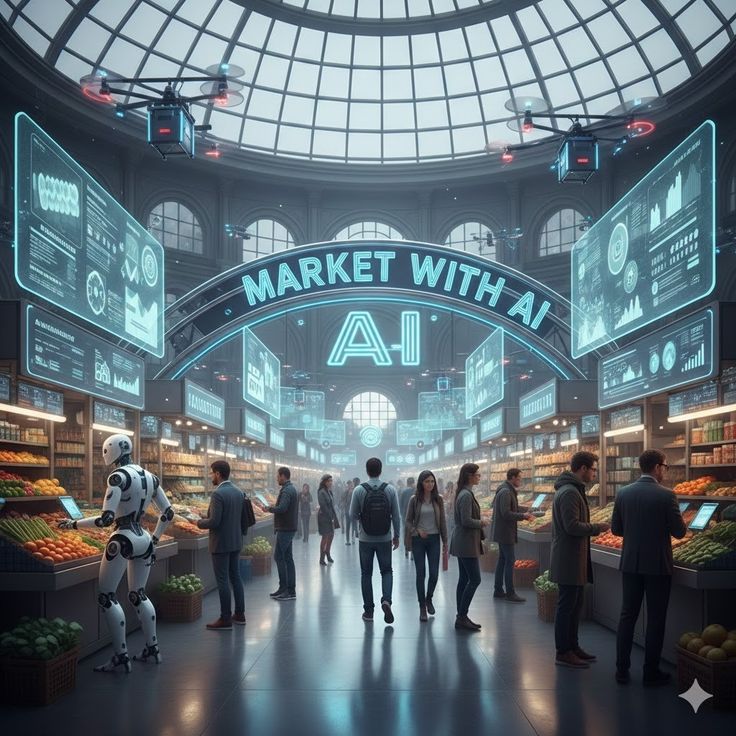
Artificial intelligence (AI) has become an essential tool for businesses seeking to understand market trends and make smarter decisions. By analyzing massive amounts of data in real time, AI helps companies identify patterns, forecast customer demand, monitor competitors, and respond quickly to changing market conditions.
From retail and finance to manufacturing and healthcare, organizations use AI-powered predictive analytics to improve planning, reduce risk, and uncover new growth opportunities.
What Is AI-Powered Market Prediction?
AI-powered market prediction involves using machine learning algorithms and data analytics to analyze historical and real-time data. These systems identify trends, recognize patterns, and generate forecasts that help businesses make informed decisions.
Unlike traditional analysis, AI can process millions of data points quickly and continuously improve its predictions as new information becomes available.
Analyzing Customer Behavior
Companies use AI to study customer purchasing habits, browsing activity, feedback, and preferences. This information helps businesses understand what customers want and predict future buying patterns.
Better customer insights allow businesses to create personalized marketing campaigns and improve customer satisfaction.
Forecasting Product Demand
AI helps businesses estimate future demand by analyzing sales history, seasonal trends, economic conditions, and consumer behavior.
Accurate demand forecasting helps companies:
- Reduce inventory shortages.
- Avoid excess stock.
- Improve supply chain planning.
- Lower operating costs.
Monitoring Market Trends
AI continuously scans news articles, financial reports, industry data, and online discussions to detect emerging market trends.
Businesses can identify new opportunities early and respond faster than competitors when market conditions change.
Improving Pricing Strategies
Many companies use AI to optimize pricing by analyzing demand, competitor pricing, customer behavior, and market conditions.
Dynamic pricing systems can automatically adjust prices to maximize revenue while remaining competitive.
Competitive Analysis
AI tools collect and analyze publicly available information about competitors, including pricing, product launches, customer reviews, and market positioning.
This enables businesses to identify strengths, weaknesses, and potential competitive advantages.
Supporting Financial Decisions
Financial institutions use AI to predict stock market trends, assess investment risks, detect fraud, and evaluate credit risk.
While AI improves data analysis and forecasting, financial markets remain unpredictable, and no AI system can guarantee future market performance.
Enhancing Marketing Campaigns
Marketing teams use AI to identify target audiences, predict campaign performance, and recommend the best channels for reaching customers.
These insights improve advertising efficiency and increase return on marketing investment.
Challenges of AI Forecasting
Although AI provides valuable insights, predictions are only as reliable as the data used to train the models. Poor-quality or biased data can reduce accuracy.
Businesses should also consider privacy regulations, ethical AI practices, and the need for human oversight when making important decisions.
The Future of AI in Market Analysis
As AI technology advances, businesses will gain access to more accurate forecasting tools, real-time analytics, and automated decision support. Integration with big data, cloud computing, and advanced machine learning will further improve market prediction capabilities.
Organizations that combine AI insights with human expertise will be better equipped to adapt to changing market conditions.
Conclusion
Artificial intelligence is transforming how companies predict market trends by analyzing large datasets, forecasting demand, optimizing pricing, and improving strategic planning. AI enables businesses to respond more quickly to customer needs and market changes while improving operational efficiency.
Although AI is a powerful decision-support tool, successful organizations combine AI-driven insights with human judgment, industry knowledge, and sound business strategy to achieve sustainable growth.
Frequently Asked Questions (FAQs)
1. How does AI predict market trends?
AI analyzes historical and real-time data to identify patterns, forecast demand, and generate predictions about future market behavior.
2. What industries use AI for market prediction?
Retail, finance, healthcare, manufacturing, logistics, technology, and e-commerce are among the industries that use AI for forecasting and planning.
3. Can AI accurately predict the stock market?
AI can identify patterns and assist with analysis, but it cannot reliably predict future stock prices or guarantee investment success because markets are influenced by many unpredictable factors.
4. How does AI help businesses understand customers?
AI analyzes purchasing behavior, preferences, browsing activity, and customer feedback to generate insights and personalize experiences.
5. What is predictive analytics?
Predictive analytics uses historical data, statistical methods, and AI to estimate future outcomes and trends.
6. How does AI improve pricing strategies?
AI evaluates demand, competition, customer behavior, and market conditions to recommend or automate pricing adjustments.
7. What are the benefits of AI demand forecasting?
It helps businesses optimize inventory, reduce waste, improve supply chain management, and better meet customer demand.
8. What challenges does AI face in market prediction?
Challenges include data quality, changing market conditions, privacy concerns, algorithmic bias, and the need for human oversight.
9. Can small businesses use AI for market analysis?
Yes. Many affordable AI-powered analytics tools are available to help small businesses understand customers, forecast demand, and improve decision-making.
10. What is the future of AI in business forecasting?
The future includes more accurate predictive models, real-time market analysis, automated decision support, and deeper integration with cloud computing and big data technologies.