

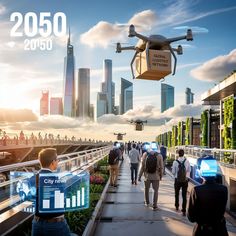
The year 2050 may seem distant, but many of the changes shaping our future are already underway. Advances in technology, shifts in population demographics, climate challenges, and economic transformations are expected to redefine how people live, work, and interact. While no prediction can be completely certain, experts across various fields have identified several trends that are likely to have a significant impact on the world by mid-century.
A More Urbanized World
By 2050, a larger share of the global population is expected to live in cities. Urban centers will continue to expand as people move from rural areas in search of better employment opportunities, education, and healthcare.
Future cities may feature smart infrastructure that uses sensors, artificial intelligence, and real-time data to manage traffic, energy consumption, and public services more efficiently. Sustainable urban planning will become increasingly important as governments seek to accommodate growing populations while minimizing environmental impact.
Artificial Intelligence Will Be Everywhere
Artificial intelligence (AI) is expected to become deeply integrated into daily life. AI-powered systems may assist with healthcare diagnoses, transportation management, education, customer service, and business operations.
Automation will likely handle many repetitive tasks, increasing productivity across industries. While some jobs may disappear due to automation, new careers focused on technology development, data analysis, cybersecurity, and AI management are expected to emerge.
Major Advances in Healthcare
Healthcare in 2050 could be more personalized, preventive, and technology-driven. Experts predict that genetic research, biotechnology, and AI will enable earlier disease detection and more targeted treatments.
Wearable devices and remote monitoring systems may continuously track health conditions, allowing doctors to intervene before serious illnesses develop. Advances in medical science could also improve life expectancy and quality of life for millions of people worldwide.
Renewable Energy Will Dominate
As nations work to reduce carbon emissions, renewable energy sources such as solar, wind, and hydropower are expected to play a larger role in global energy production. Improvements in battery technology and energy storage systems could make clean energy more reliable and affordable.
Many experts believe that electric vehicles will become the standard form of transportation in many countries, reducing dependence on fossil fuels and helping to combat climate change.
Climate Change Will Shape Global Priorities
Climate change is expected to remain one of the most significant challenges facing humanity. Rising temperatures, extreme weather events, and changing ecosystems may affect agriculture, water supplies, and coastal communities.
Governments and businesses will likely invest heavily in climate adaptation measures, including resilient infrastructure, sustainable farming practices, and advanced environmental monitoring systems. Climate policies will increasingly influence economic and political decisions around the world.
The Future of Work
Remote and hybrid work models may become a permanent feature of the global workforce. Advances in communication technology will enable people to collaborate across continents with greater ease.
Workers will need to adapt continuously as technology changes the skills demanded by employers. Lifelong learning and professional development are expected to become essential components of career success.
Space Exploration and Commercial Space Travel
The space industry is likely to expand significantly by 2050. Private companies and national space agencies may establish permanent lunar bases and conduct more ambitious missions to Mars.
Commercial space tourism could become more accessible, though still expensive for many travelers. Space-based technologies may also improve communication systems, navigation, and scientific research.
Demographic Changes
Population growth patterns will vary across regions. Some countries may experience rapid population increases, while others face aging populations and declining birth rates.
These demographic shifts will influence labor markets, healthcare systems, pension programs, and economic growth. Governments will need innovative policies to address the challenges and opportunities created by changing population structures.
Education in a Digital Era
Education is expected to become more flexible and personalized. Artificial intelligence, virtual reality, and online learning platforms may provide customized educational experiences tailored to individual learning styles.
Students could access high-quality educational resources from anywhere in the world, helping to reduce barriers to learning and improve global knowledge sharing.
Economic Transformation
The global economy of 2050 may be driven by digital technologies, green industries, and knowledge-based services. Emerging markets are expected to play an increasingly important role in global trade and innovation.
Businesses that embrace sustainability, technological innovation, and workforce development will likely be better positioned to succeed in a rapidly changing economic environment.
Conclusion
The world of 2050 is expected to be more connected, technologically advanced, and environmentally conscious than today. Artificial intelligence, renewable energy, healthcare innovations, and urban development will reshape societies across the globe. At the same time, challenges such as climate change, workforce transitions, and demographic shifts will require thoughtful solutions. While the future cannot be predicted with complete certainty, the trends emerging today provide valuable insights into what life may look like in the decades ahead.
Frequently Asked Questions (FAQs)
1. What is expected to be the biggest technological change by 2050?
Artificial intelligence is widely expected to have the greatest impact, influencing industries such as healthcare, transportation, education, and business.
2. Will renewable energy replace fossil fuels by 2050?
Many experts believe renewable energy will account for a much larger share of global energy production, though fossil fuels may still be used in some sectors.
3. How will climate change affect life in 2050?
Climate change may lead to more extreme weather events, rising sea levels, and increased pressure on natural resources, making adaptation strategies essential.
4. What jobs will be in demand in 2050?
Careers related to AI, data science, cybersecurity, renewable energy, healthcare, biotechnology, and environmental management are expected to see strong demand.
5. Will people live longer in 2050?
Advances in healthcare, disease prevention, and medical technology may increase average life expectancy in many parts of the world.
6. How will education change by 2050?
Education is expected to become more personalized through AI, digital learning platforms, and immersive technologies such as virtual reality.
7. Could humans live on other planets by 2050?
While permanent settlements on Mars remain uncertain, experts expect significant progress in lunar bases and long-term space exploration projects.
8. What will cities look like in 2050?
Future cities are likely to be smarter, more sustainable, and highly connected through advanced technologies that improve transportation, energy use, and public services.