

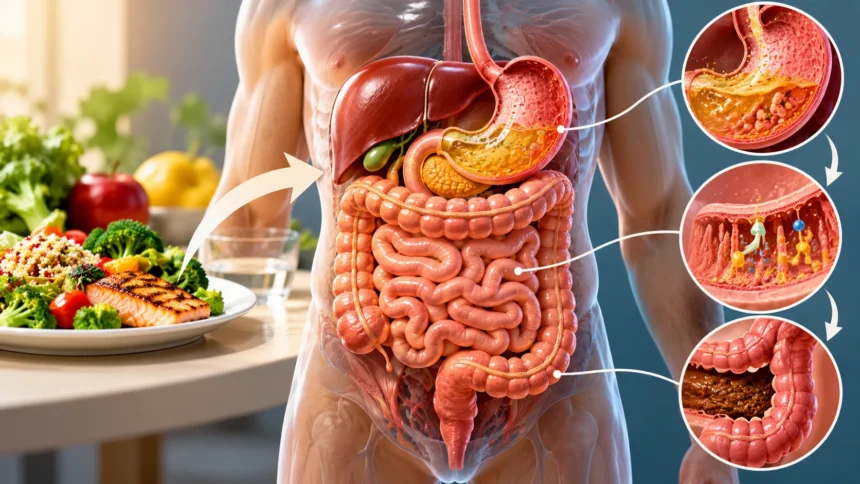
The digestive system is one of the most important systems in the human body. It breaks down the food we eat into smaller substances that the body can absorb and use for energy, growth, and normal functioning. Every meal passes through a series of digestive organs that work together to process food, absorb nutrients, and remove waste.
Digestion begins before food reaches the stomach. Chewing, saliva, stomach acid, digestive enzymes, and muscular movements all play important roles in breaking down food. The small intestine absorbs most nutrients, while the large intestine helps absorb water and form solid waste.
Understanding how the digestive system breaks down food can help you learn more about the human body and the importance of healthy digestion. This guide explains the digestive process step by step, the functions of major digestive organs, and how different nutrients are processed. It also covers common digestive problems and practical habits that support digestive health.
What Is the Digestive System?
The digestive system is a group of organs responsible for processing food and converting it into substances the body can absorb. It includes the mouth, esophagus, stomach, small intestine, large intestine, rectum, and anus. Several additional organs, including the liver, pancreas, and gallbladder, also support digestion by producing or storing important digestive substances.
The main purpose of digestion is to break food into smaller molecules that can pass through the intestinal lining. These nutrients include glucose, amino acids, fatty acids, vitamins, and minerals. Once absorbed, they become available to the body’s cells for energy production, tissue maintenance, and other essential functions.
Digestion involves a combination of physical movements and chemical reactions. Muscles move food through the digestive tract, while enzymes and other substances break down carbohydrates, proteins, and fats. These processes work together automatically, although their efficiency can be influenced by health conditions, medications, and dietary factors.
How Does the Digestive System Break Down Food?
The digestive system breaks down food through two main processes known as mechanical digestion and chemical digestion. Mechanical digestion physically divides food into smaller pieces through chewing and muscular mixing. Chemical digestion uses enzymes and digestive substances to break complex food molecules into simpler forms.
The process begins in the mouth, continues through the stomach, and is completed mainly in the small intestine. Each organ performs a specific task that prepares food for the next stage. Coordinated muscular contractions move the contents forward while digestive fluids help break down different nutrients.
After digestion, useful nutrients are absorbed into the bloodstream or lymphatic system. The remaining material travels into the large intestine, where water and certain electrolytes are absorbed. Waste is eventually stored in the rectum before leaving the body through the anus.
Step 1: Digestion Begins in the Mouth
Digestion begins when food enters the mouth and is broken into smaller pieces through chewing. The teeth cut, crush, and grind food, increasing its surface area. This makes it easier for digestive enzymes to interact with food and helps prepare it for swallowing.
Salivary glands produce saliva, which moistens food and contains substances involved in digestion. Salivary amylase begins breaking down some starches into smaller carbohydrates. The tongue mixes food with saliva and helps form a soft mass called a bolus that can be swallowed comfortably.
Chewing is an important part of mechanical digestion because it reduces the size of food particles. Swallowing then moves the bolus toward the throat and esophagus. Although digestion starts in the mouth, most chemical digestion and nutrient absorption occur later in the digestive tract.
Step 2: Food Travels Through the Esophagus
The esophagus is a muscular tube connecting the throat to the stomach. After swallowing, food passes into the esophagus and moves downward through coordinated muscular contractions. These wave-like movements are called peristalsis and help transport food without relying entirely on gravity.
During swallowing, the body coordinates several muscles to direct food toward the digestive tract. The epiglottis helps protect the airway as swallowing occurs. Once food enters the esophagus, muscular activity continues moving it toward the stomach.
At the lower end of the esophagus, a muscular valve called the lower esophageal sphincter helps regulate passage into the stomach. It normally closes after food passes through, limiting the movement of stomach contents backward. Problems with this barrier can contribute to acid reflux and related symptoms.
Step 3: The Stomach Mixes and Digests Food
The stomach is a muscular organ that temporarily stores food and mixes it with digestive juices. Its muscular walls contract to break food into smaller particles and combine it with stomach secretions. This process produces a semi-liquid mixture called chyme.
Stomach glands release hydrochloric acid and digestive enzymes that help process food. The acidic environment supports the activity of pepsin, an enzyme involved in protein digestion. The stomach also produces protective mucus that helps shield its lining from the effects of digestive acid.
Food does not remain in the stomach for a fixed amount of time. Emptying depends on meal composition, quantity, and individual digestive function. Chyme gradually passes into the small intestine, where most nutrient digestion and absorption take place.
Step 4: The Small Intestine Completes Most Digestion
The small intestine is the main location where food is chemically digested and nutrients are absorbed. It consists of three sections: the duodenum, jejunum, and ileum. Together, these regions process chyme arriving from the stomach and prepare nutrients for absorption.
In the duodenum, digestive fluids from the pancreas and bile from the liver and gallbladder help process food. Pancreatic enzymes break down carbohydrates, proteins, and fats into smaller components. Bile supports the digestion of fats by helping disperse them into smaller droplets.
The small intestine contains specialized structures that increase the area available for nutrient absorption. Tiny projections called villi and microvilli provide a large surface through which nutrients can pass. Most digested nutrients are absorbed here before being transported to other parts of the body.
Step 5: The Large Intestine Absorbs Water
After most nutrients have been absorbed, the remaining material enters the large intestine. This organ includes the colon and contributes to water and electrolyte absorption. It also contains a large community of microorganisms that participate in processing certain undigested substances.
Gut bacteria can ferment some dietary fibers and other carbohydrates that were not digested in the small intestine. This process produces substances called short-chain fatty acids, which can support normal intestinal function. Gas is another natural byproduct of microbial fermentation.
As water is absorbed, the remaining material gradually becomes more solid and forms stool. The large intestine moves this waste toward the rectum through muscular activity. Normal bowel habits vary between individuals, and stool consistency is influenced by several dietary and health factors.
Step 6: The Body Removes Undigested Waste
The final stage of digestion involves removing material that the body cannot absorb or use. After passing through the colon, stool enters the rectum, where it is temporarily stored. Stretch receptors and nervous system signals help coordinate the urge to have a bowel movement.
The rectum and anal sphincter muscles work together to control the release of stool. Bowel movements are a normal part of digestive function and help eliminate undigested material, bacteria, and other waste products. The frequency of bowel movements varies from person to person.
Healthy digestion does not require everyone to follow the same bathroom schedule. However, persistent constipation, diarrhea, blood in stool, or unexplained changes in bowel habits should receive medical attention. These symptoms can have many causes and may require professional evaluation.
What Is Mechanical Digestion?
Mechanical digestion is the physical breakdown of food into smaller pieces without changing its basic chemical composition. It begins with chewing in the mouth and continues through muscular movements in the stomach and intestines. This process helps expose more of the food to digestive enzymes.
The teeth are responsible for the earliest mechanical breakdown of food. The stomach then mixes its contents through repeated muscular contractions. Movements within the intestines also help blend food with digestive fluids and bring nutrients into contact with the intestinal lining.
Mechanical digestion works together with chemical digestion rather than replacing it. Breaking food into smaller pieces creates more surface area for enzymes to act upon. Both processes are necessary for the body to digest and absorb nutrients efficiently.
What Is Chemical Digestion?
Chemical digestion involves breaking large food molecules into smaller substances through chemical reactions. Digestive enzymes play a major role in this process because they help split carbohydrates, proteins, and fats. The smaller molecules can then be absorbed through the intestinal lining.
Chemical digestion begins in the mouth when salivary amylase starts acting on starch. It continues in the stomach, where pepsin begins breaking down proteins. Most chemical digestion takes place in the small intestine with help from pancreatic enzymes and enzymes associated with the intestinal lining.
Different enzymes are specialized for different nutrients. Amylases act on starches, proteases break down proteins, and lipases help digest fats. Without these processes, many nutrients would remain too large for efficient absorption by the body.
How Does the Body Digest Carbohydrates?
Carbohydrates are an important source of energy for the body. Foods such as bread, rice, potatoes, fruits, and vegetables contain different types of carbohydrates. During digestion, many of these carbohydrates are broken down into smaller sugars that the body can absorb.
Carbohydrate digestion begins in the mouth with salivary amylase. The process continues mainly in the small intestine, where pancreatic amylase and intestinal enzymes help produce absorbable sugars. Glucose is one of the major products of carbohydrate digestion.
After absorption, glucose travels through the bloodstream and becomes available to body cells. The hormone insulin helps regulate how glucose is used and stored. Dietary fiber behaves differently because many types are not broken down by human digestive enzymes and instead pass into the large intestine.
How Does the Body Digest Proteins?
Proteins are essential nutrients used to build and maintain muscles, organs, enzymes, and other body tissues. They are made of smaller units called amino acids. During digestion, the digestive system breaks proteins into amino acids and smaller peptides that can be absorbed.
Protein digestion begins primarily in the stomach, where hydrochloric acid helps unfold proteins and activates pepsin. Pepsin breaks some protein chains into smaller fragments. The partially digested material then passes into the small intestine for further processing.
Pancreatic and intestinal enzymes complete much of the remaining protein digestion. The resulting amino acids and small peptides are absorbed through the intestinal lining. These nutrients are then used by the body for tissue maintenance, growth, and many important biological functions.
How Does the Body Digest Fats?
Fats are important nutrients involved in energy storage, cell structure, and the absorption of certain vitamins. Foods such as nuts, seeds, oils, and dairy products contain different types of fats. Because fats do not mix easily with water, their digestion involves specialized processes.
Most fat digestion occurs in the small intestine. Bile, produced by the liver and stored in the gallbladder, helps disperse larger fat droplets into smaller ones. This process is called emulsification and increases the surface area available for digestive enzymes.
Pancreatic lipase breaks down many dietary triglycerides into smaller components that can be absorbed by intestinal cells. Much of the absorbed fat is then packaged into particles that enter the lymphatic system before reaching the bloodstream. This process allows the body to transport and use dietary fats.
What Role Does the Liver Play in Digestion?
The liver is a major organ involved in processing nutrients and supporting normal digestion. One of its important digestive functions is producing bile, a fluid that helps the small intestine process dietary fats. Bile contains substances that assist with fat emulsification.
After nutrients are absorbed from the digestive tract, many travel to the liver through the portal circulation. The liver helps process and store certain nutrients and participates in regulating blood glucose levels. It also performs numerous functions related to metabolism and the removal of potentially harmful substances.
Although the liver produces bile, it does not directly store the fluid in most circumstances. Instead, bile can be stored and concentrated in the gallbladder between meals. The liver and gallbladder therefore work together to support the digestion and absorption of fats.
What Does the Pancreas Do During Digestion?
The pancreas is an organ located behind the stomach that performs important digestive and hormonal functions. Its digestive role involves producing enzymes that help break down carbohydrates, proteins, and fats. These enzymes are released into the small intestine through pancreatic ducts.
The pancreas also releases bicarbonate-rich fluid that helps neutralize acidic chyme arriving from the stomach. This creates conditions that allow digestive enzymes to function effectively. Without sufficient pancreatic secretions, the digestion and absorption of certain nutrients can become impaired.
In addition to digestion, the pancreas produces hormones such as insulin and glucagon. These hormones help regulate blood glucose levels. The pancreas therefore supports both the chemical breakdown of food and the body’s ability to manage nutrients after absorption.
What Does the Gallbladder Do During Digestion?
The gallbladder is a small organ located beneath the liver. Its primary function is to store and concentrate bile between meals. When food containing fat enters the small intestine, digestive signals can trigger the gallbladder to release bile.
Bile travels through ducts into the small intestine, where it helps disperse dietary fats. This allows pancreatic enzymes to digest fats more effectively. Bile also supports the absorption of fat-soluble vitamins, including vitamins A, D, E, and K.
The gallbladder supports digestion but is not essential for survival. People who have had their gallbladder removed can still digest food because the liver continues producing bile. However, some individuals experience digestive changes after gallbladder surgery and may need personalized dietary guidance.
How Are Nutrients Absorbed Into the Body?
Nutrient absorption occurs mainly in the small intestine after food has been broken into smaller components. The intestinal lining contains specialized cells that transport nutrients into the body. Its large surface area allows many different nutrients to be absorbed efficiently.
Water-soluble nutrients such as glucose and amino acids generally enter blood vessels within the intestinal villi. Many dietary fats follow a different pathway through the lymphatic system before entering the bloodstream. Vitamins and minerals are absorbed through several mechanisms depending on their chemical properties.
Once absorbed, nutrients are transported to tissues that need them for normal function. The liver helps process many substances before they enter the wider circulation. Efficient nutrient absorption depends on healthy intestinal tissue, appropriate digestive enzymes, and coordinated digestive activity.
How Long Does It Take to Digest Food?
Digestion does not occur at exactly the same speed for every person or meal. The time food spends in the stomach and intestines depends on meal size, nutrient composition, medications, and individual digestive function. Different parts of a meal may also move through the digestive system at different rates.
The stomach often empties a substantial portion of a typical meal over several hours. Food then travels through the small intestine while digestion and nutrient absorption continue. Movement through the large intestine can take considerably longer as water is absorbed and stool forms.
The complete journey through the digestive tract may take approximately one to three days, although normal variation can be wider. Faster or slower digestion is not automatically a sign of a problem. Persistent symptoms or significant changes in bowel habits should be discussed with a healthcare professional.
How Does the Gut Microbiome Support Digestion?
The gut microbiome consists of microorganisms that live within the digestive tract, particularly the large intestine. These include bacteria and other microbes that interact with food components and the intestinal environment. Their activities contribute to several aspects of normal digestive function.
Some gut microorganisms help ferment dietary fibers that human digestive enzymes cannot break down. This process produces short-chain fatty acids and other substances that interact with intestinal cells. The microbiome also participates in processes involving certain vitamins and immune function.
The composition of the gut microbiome differs between individuals and changes over time. Diet, medications, illness, and other factors can influence these microbial communities. Research continues to explore how the microbiome affects digestive health and different medical conditions.
Common Digestive Problems and Their Causes
Digestive problems can occur when one or more parts of the digestive system do not function normally. Common symptoms include bloating, heartburn, constipation, diarrhea, and abdominal discomfort. These symptoms may have several possible causes and do not always indicate a serious medical condition.
Food intolerances, infections, medications, and certain digestive disorders can affect normal digestion. For example, lactose intolerance occurs when the body has difficulty digesting lactose because of reduced lactase enzyme activity. Acid reflux can develop when stomach contents move backward into the esophagus.
Persistent or severe digestive symptoms should not be ignored. Blood in stool, unexplained weight loss, difficulty swallowing, or severe abdominal pain require medical assessment. Identifying the underlying cause is important because different digestive conditions may require different approaches to treatment.
How to Support a Healthy Digestive System
A balanced eating pattern can support normal digestive function by providing a variety of nutrients and dietary fibers. Fruits, vegetables, whole grains, legumes, and other suitable foods contribute different substances that the body uses. Eating a varied diet also supports the needs of many beneficial gut microorganisms.
Adequate hydration helps support normal bodily functions, including digestion and bowel movements. Regular physical activity can also contribute to digestive health and general well-being. Individual needs vary according to age, health, activity level, and other personal factors.
Eating at a comfortable pace and paying attention to digestive symptoms may help people understand their own tolerance of different foods. Unnecessarily restrictive diets are not required for healthy digestion. If certain foods repeatedly cause discomfort, a healthcare professional can help determine whether testing or dietary adjustments are appropriate.
Why Is the Digestive System Important for Overall Health?
The digestive system makes nutrients available for the body’s many activities. Without digestion and absorption, cells would not receive sufficient supplies of energy and essential building materials. The digestive organs therefore contribute to growth, tissue repair, and normal physical development.
Digestion is also closely connected with the nervous, hormonal, and immune systems. Specialized signals coordinate digestive secretions, muscular movement, and feelings of fullness. The intestinal barrier and associated immune cells help the body interact with substances and microorganisms entering through food.
A healthy digestive system contributes to general well-being, but occasional changes in digestion are common. Long-term digestive difficulties can interfere with nutrient absorption and daily comfort. Understanding how the system works makes it easier to recognize when symptoms may need professional attention.
Conclusion
The digestive system breaks down food through a coordinated process involving mechanical movement, digestive enzymes, and specialized organs. Digestion begins in the mouth, continues through the stomach, and is completed mainly in the small intestine. Each stage prepares nutrients for absorption and helps the body obtain essential substances from food.
The liver, pancreas, and gallbladder provide important support by producing or storing digestive fluids. The small intestine absorbs most nutrients, while the large intestine absorbs water and processes remaining material. Undigested waste eventually leaves the body through normal bowel movements.
Understanding how digestion works highlights the importance of a balanced diet, adequate hydration, and overall digestive health. Most digestive processes happen automatically, allowing the body to use nutrients for everyday activities. When persistent or concerning symptoms occur, medical advice can help identify possible causes and suitable care.
Frequently Asked Questions
1. How Does the Digestive System Break Down Food?
The digestive system uses chewing, muscular movements, stomach acid, bile, and digestive enzymes to break food into smaller substances. Nutrients are then absorbed mainly through the small intestine.
2. Where Does Digestion Begin in the Human Body?
Digestion begins in the mouth. Teeth mechanically break food into smaller pieces, while saliva moistens food and contains amylase, an enzyme that starts digesting certain carbohydrates.
3. Which Organ Does Most of the Digestion?
The small intestine performs most chemical digestion and nutrient absorption. It receives digestive enzymes from the pancreas and bile from the liver to help process carbohydrates, proteins, and fats.
4. How Long Does the Human Body Take to Digest Food?
Digestion and movement through the digestive tract commonly take approximately one to three days, although normal variation is considerable. Meal composition, individual physiology, and other factors influence the timing.
5. What Happens to Food That Cannot Be Digested?
Undigested material moves into the large intestine, where water is absorbed and gut microorganisms process certain substances. The remaining waste forms stool, which is eventually eliminated through the rectum and anus.