

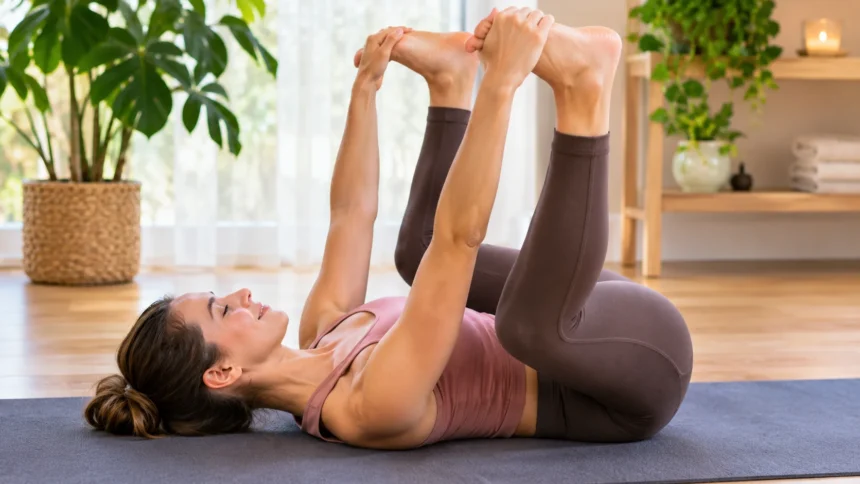
Happy Baby Pose yoga is a gentle floor-based stretch that helps release tension around the hips, inner thighs, and lower back. Known as Ananda Balasana in Sanskrit, this popular yoga position involves lying on your back while holding your feet or legs with your knees comfortably bent. It is commonly practiced during relaxing yoga sessions, cooldown routines, and gentle mobility exercises.
Unlike challenging yoga poses that require strength or advanced balance, Happy Baby Pose focuses on comfortable movement and relaxation. However, performing it correctly is important because pulling too strongly or forcing the hips into an uncomfortable position may create unnecessary strain. Understanding proper alignment can make the stretch more enjoyable and accessible.
Whether you are new to yoga or want to improve your flexibility, learning how to do Happy Baby Pose can support a more comfortable movement routine. This guide explains its benefits, correct form, beginner-friendly modifications, common mistakes, and essential safety precautions.
What Is Happy Baby Pose in Yoga?
Happy Baby Pose is a reclining yoga position that involves bringing the knees toward the upper body while gently opening the hips. The traditional version includes holding the outer edges of the feet while lying on the back. Its shape resembles a baby lying comfortably with raised legs.
The Sanskrit name for Happy Baby Pose is Ananda Balasana. In yoga, Ananda refers to happiness or bliss, while Balasana relates to a child pose. Although the name sounds similar to Child’s Pose, the two positions are different. Happy Baby Pose is performed on the back, while Child’s Pose is generally practiced in a kneeling position.
This pose is commonly included in restorative yoga, gentle stretching routines, and cooldown sessions. It does not require expensive equipment or advanced experience. However, individual flexibility and joint comfort vary, so the position should be adjusted rather than forced into a particular shape.
What Muscles Does Happy Baby Pose Stretch?
Happy Baby Pose primarily stretches muscles around the hips and inner thighs. These include portions of the hip adductors, which help bring the legs toward the body’s midline. The position may also create a gentle stretching sensation around the gluteal muscles and surrounding hip tissues.
The lower back may feel more relaxed while the spine rests against the floor. However, Happy Baby Pose is not a direct strengthening exercise for the back muscles. Its main purpose is to encourage comfortable positioning and gentle hip mobility. The exact sensation depends on your anatomy, flexibility, and how you perform the pose.
The hamstrings may experience some tension, but they are not the main stretching target because the knees remain bent. Straightening the legs substantially changes the movement and can increase muscular demands. Keeping the knees comfortably bent allows the pose to emphasize the hips without requiring advanced hamstring flexibility.
Benefits of Happy Baby Pose Yoga
One of the main benefits of Happy Baby Pose yoga is its ability to encourage gentle hip mobility. The position allows the hips to move into flexion and abduction while the body remains supported by the floor. Practicing within a comfortable range may help reduce temporary feelings of stiffness.
Another potential benefit is relaxation. The supported position can feel calming, especially when combined with slow, comfortable breathing. Some people find that gentle stretching helps them unwind after a long day or physical activity. However, individual experiences vary, and the pose should not be considered a guaranteed treatment for stress.
Happy Baby Pose can also improve awareness of hip positioning and body movement. It encourages attention to breathing, comfort, and joint alignment. These qualities make it a useful addition to gentle yoga sessions. Its benefits are best understood as part of regular, balanced physical activity rather than as a solution to every mobility problem.
How to Do Happy Baby Pose Step by Step
Begin by lying comfortably on your back on a yoga mat or another supportive surface. Bend your knees and bring them toward your upper body without forcing the movement. Allow your lower back and shoulders to rest naturally. Your head should remain comfortably supported rather than lifting forward.
Next, gently separate your knees and bring them toward the sides of your torso. If comfortable, reach for the outer edges of your feet while keeping the knees bent. Your ankles should remain approximately above your knees, although exact alignment can vary. Avoid pulling your feet downward with excessive force.
Breathe slowly while allowing your hips to relax into the position. Hold the stretch only as long as it feels comfortable, then release your feet and lower your legs gently. If reaching the feet causes strain, hold your thighs instead. The correct version is one that allows smooth breathing and controlled movement without pain.
Proper Alignment for Happy Baby Pose
Proper alignment helps make Happy Baby Pose more comfortable and reduces unnecessary strain. Begin with your head, shoulders, and back resting naturally on the floor. Keep your neck relaxed and avoid pressing your chin forcefully toward your chest. Your body should feel supported throughout the movement.
The knees generally move outward toward the sides of the torso, while the ankles remain above them as comfortably as possible. However, there is no need to force the legs into a perfectly symmetrical position. Differences in hip anatomy and mobility can affect how the pose looks from person to person.
Your lower back may naturally change position slightly as you move into the stretch. Avoid aggressively flattening the spine or allowing the pelvis to roll into an uncomfortable position. Gentle adjustments can help maintain comfort. If a particular alignment creates pain or pressure, reduce the range of motion or try a supported variation.
How Long Should You Hold Happy Baby Pose?
The appropriate holding time depends on your experience, comfort, and reason for practicing. Beginners may find that approximately 15–30 seconds feels manageable. Others may prefer a longer, gentle hold during a restorative yoga session. There is no universal duration that produces the best results for everyone.
Focus on comfortable breathing rather than counting seconds precisely. A stretch that allows you to relax is generally more useful than one that requires constant effort. If your muscles begin to tense or your breathing becomes difficult, reduce the stretch or release the position.
Longer holds are not automatically more effective. Forcing a deep stretch over time can irritate sensitive muscles or joints. You may repeat the position after a short rest if it remains comfortable. Gradual practice and attention to your body’s response are more important than attempting to maintain the pose for a predetermined duration.
Happy Baby Pose for Beginners
Beginners often find Happy Baby Pose more approachable when they focus on the position of the hips rather than trying to hold both feet immediately. Limited flexibility or unfamiliar movement patterns may make the traditional version uncomfortable. Fortunately, several modifications allow people to explore the same general movement with less effort.
One beginner-friendly option is to hold the backs of the thighs instead of the feet. This reduces the need to reach forward and may make it easier to maintain a comfortable position. Keep your knees bent and gently open them only as far as feels natural.
Another option is to practice with one leg at a time. Keep one foot resting on the floor while bringing the opposite knee toward the side of the torso. This can make the position easier to control. Beginners should prioritize comfort and breathing rather than trying to reproduce a particular yoga photograph.
Happy Baby Pose With a Yoga Strap
A yoga strap can provide support when reaching the feet feels difficult. It allows the arms to remain in a more comfortable position while the hips move gently through the stretch. This modification may be useful for people with limited flexibility or restricted shoulder movement.
Begin by lying on your back with your knees bent. Position an appropriate yoga strap around the supported areas of your feet, following the equipment’s instructions. Hold the strap securely without wrapping it tightly around your hands. Gently guide your legs into a comfortable position while keeping the movement controlled.
The strap should support the stretch rather than create stronger pulling forces. Avoid using it to force your knees toward the floor or your chest. If the position causes hip, knee, or back discomfort, reduce the tension or stop. A comfortable supported version can provide a useful alternative to the traditional pose.
One-Leg Happy Baby Pose Variation
The one-leg Happy Baby Pose is a modification that focuses on one hip at a time. It may be easier to manage for people who find the full position uncomfortable or difficult to coordinate. This variation also allows you to notice differences in mobility between the two sides.
Lie on your back with both knees bent and your feet on the floor. Bring one knee toward the side of your torso and gently hold the thigh or foot if comfortable. Keep the opposite leg supported in a relaxed position. Avoid forcing the moving knee into a deeper stretch.
After a comfortable hold, release the leg slowly and repeat on the other side. Differences in flexibility are common and do not necessarily indicate a problem. The movement should remain gentle and controlled. If one side produces pain or unusual symptoms, stop rather than attempting to match the opposite side.
Happy Baby Pose for Hip Flexibility
Happy Baby Pose is often included in yoga routines designed to support hip mobility. Its position combines hip flexion with outward movement of the legs, creating a gentle stretch around the inner thighs. This can be useful for people who want to explore comfortable movement in different hip positions.
However, hip flexibility is influenced by several factors, including joint structure, muscle tolerance, and previous activity. Some people naturally have a wider range of motion than others. A deeper position is not automatically healthier or more effective. The goal should be comfortable mobility that supports everyday activities.
For general hip conditioning, Happy Baby Pose can be combined with suitable strengthening and mobility exercises. Gentle movement may complement activities such as walking and lower-body strength training. However, stretching alone does not address every cause of hip stiffness. Persistent pain or restricted movement may require professional assessment.
Happy Baby Pose for Lower Back Comfort
Happy Baby Pose may feel relaxing for some people who experience temporary lower-back stiffness. Lying on the floor provides support, while the bent-knee position can create a comfortable sensation around the hips. Gentle breathing may also help reduce unnecessary muscular tension during the stretch.
However, the pose is not suitable for every cause of lower-back pain. Certain positions may aggravate symptoms involving spinal joints, nerves, or other structures. If bringing your knees toward your chest produces discomfort, reduce the movement or avoid the pose. Pain should never be treated as a sign that a stretch is working.
People with persistent back pain should seek guidance about appropriate movement options. A physical therapist can assess individual symptoms and recommend suitable exercises. Happy Baby Pose may be one component of a broader mobility routine, but it should not replace medical evaluation when symptoms are severe, recurring, or unexplained.
Happy Baby Pose for Stress Relief and Relaxation
Many yoga practitioners use Happy Baby Pose during the relaxing portion of a session. The supported position can encourage slower movement and attention to breathing. It may also provide an opportunity to pause after more demanding exercises. These qualities can make the stretch feel calming for some individuals.
Comfortable breathing plays an important role in the experience. Instead of holding your breath or pulling your legs strongly, allow the movement to remain gentle. Pay attention to sensations around the hips and back without forcing changes. This approach can help create a more relaxed and controlled yoga practice.
However, relaxation responses vary between individuals. Some people may find this position uncomfortable or prefer other restorative poses. There is no need to continue an exercise that creates distress or physical discomfort. A suitable relaxation routine should reflect your personal preferences and physical needs.
Common Happy Baby Pose Mistakes to Avoid
One common mistake is pulling the feet too strongly toward the floor. This can place unnecessary pressure on the hips, knees, or lower back. The purpose of Happy Baby Pose is to create a comfortable stretch rather than force the joints into an extreme position. Gentle movement is more appropriate.
Another mistake is lifting the head and shoulders while trying to reach the feet. This may create tension in the neck and upper body. Using a yoga strap or holding the thighs can make the position easier. Keeping the head comfortably supported allows the body to relax.
People may also hold their breath or ignore discomfort while trying to maintain the traditional pose. These habits can make the movement feel unnecessarily difficult. Focus on natural breathing and a manageable range of motion. If the exercise produces sharp pain, tingling, or increasing discomfort, stop and reassess the position.
Happy Baby Pose vs. Child’s Pose
Happy Baby Pose and Child’s Pose are both common yoga positions, but they involve different body arrangements. Happy Baby Pose is performed while lying on the back with the knees bent and separated. Child’s Pose generally involves kneeling and folding the upper body forward over the legs.
Happy Baby Pose emphasizes comfortable hip opening and inner-thigh stretching. Child’s Pose may provide a different sensation through the back, hips, and shoulders depending on the variation. Both positions can be used during gentle yoga sessions, but their effects and comfort levels differ.
Neither pose is automatically better for everyone. People with knee discomfort may find certain kneeling positions difficult, while those with particular hip or back conditions may prefer to avoid Happy Baby Pose. Choosing a suitable option depends on individual needs and comfort. Modifications can make either position more accessible.
When Should You Avoid Happy Baby Pose?
Happy Baby Pose may need to be avoided or modified when someone has an injury affecting the hips, knees, or lower back. Conditions involving significant joint instability or recent surgery can also require special precautions. The appropriate decision depends on the injury, medical history, and guidance from a qualified professional.
Pregnancy may require modifications, particularly when lying flat on the back becomes uncomfortable or is discouraged by a prenatal care professional. Individual recommendations can vary according to pregnancy stage and medical circumstances. Prenatal yoga should prioritize safe, supported movement rather than maintaining traditional positions at all costs.
Stop the pose if you experience sharp pain, numbness, dizziness, or unusual discomfort. These symptoms should not be ignored or treated as ordinary stretching sensations. If symptoms persist or affect everyday activities, seek professional medical guidance. Yoga should support comfortable movement rather than worsen an existing condition.
How Often Should You Practice Happy Baby Pose?
Happy Baby Pose can be included in a gentle stretching or yoga routine when it feels comfortable. Some people enjoy practicing it after exercise, while others prefer using it during a relaxing evening session. The appropriate frequency depends on personal preferences, activity levels, and physical needs.
You do not need to practice the pose for long periods to make it part of your routine. A short, comfortable hold can provide an opportunity to explore hip movement and relaxation. Other mobility exercises may complement it by moving the hips through different positions.
Consistency is useful, but it should not become a reason to ignore discomfort. Some days your body may feel less flexible or more tired than usual. Adjusting the range of motion or choosing another exercise is appropriate. A balanced routine should remain comfortable and allow sufficient recovery when needed.
Best Yoga Poses to Pair With Happy Baby Pose
Happy Baby Pose can be combined with other gentle yoga movements to create a balanced stretching routine. Reclined knee-to-chest stretches and comfortable spinal movements may provide additional mobility opportunities. These exercises involve different positions and can help individuals explore movement without relying entirely on one stretch.
A gentle Cat-Cow sequence may also complement Happy Baby Pose by introducing controlled spinal movement. Similarly, a comfortable reclined butterfly position can create a different sensation around the hips. However, each movement should be adjusted to individual flexibility and joint comfort.
The most useful routine includes positions that feel manageable and serve a clear purpose. There is no need to perform every yoga pose during one session. Beginners may benefit from learning a few simple movements and practicing them carefully. Quality of movement is more important than the number of exercises completed.
Best Practices for Safe Happy Baby Pose Yoga
Practicing Happy Baby Pose safely begins with choosing a comfortable, stable surface. A yoga mat may provide cushioning, while additional support can be useful when necessary. Ensure there is enough space to move your legs freely without contacting nearby objects. A quiet environment may also make relaxation easier.
Warm, comfortable muscles may tolerate gentle stretching more easily than muscles that feel unusually stiff. Light movement before yoga can help you assess how your body feels. However, aggressive warming exercises are unnecessary. The pose should remain controlled and comfortable throughout the session.
Most importantly, avoid comparing your flexibility with photographs or other practitioners. Hip anatomy and movement ranges differ naturally between individuals. A modified version can be just as appropriate as the traditional pose. Focus on comfortable breathing, gentle alignment, and gradual movement rather than achieving a particular appearance.
Conclusion
Happy Baby Pose yoga is a gentle reclining position that encourages comfortable hip mobility, inner-thigh stretching, and relaxation. Its supported nature makes it accessible to many beginners when appropriate modifications are used. Learning proper alignment helps reduce unnecessary strain and makes the movement easier to enjoy.
The traditional pose involves lying on the back, bending the knees, and gently holding the feet while opening the hips. However, reaching the feet is not essential. Holding the thighs, using a yoga strap, or practicing one leg at a time can provide comfortable alternatives. Individual flexibility should guide each variation.
Whether you practice Happy Baby Pose after exercise or during a gentle yoga session, comfort should remain the priority. Avoid forcing movement, pay attention to unusual symptoms, and adapt the pose when necessary. With appropriate technique and realistic expectations, Happy Baby Pose can become a useful part of a balanced mobility and relaxation routine.
Frequently Asked Questions
What Is Happy Baby Pose Good For?
Happy Baby Pose may help encourage gentle hip mobility, stretch the inner thighs, and support relaxation. It can also provide a comfortable floor-based movement during yoga sessions when performed without forcing the joints.
How Do You Do Happy Baby Pose Correctly?
Lie on your back, bend your knees toward your torso, and gently open your hips. Hold your feet or thighs comfortably, breathe naturally, and avoid pulling your legs into painful positions.
How Long Should You Hold Happy Baby Pose?
Beginners may start with approximately 15–30 seconds if comfortable. Longer gentle holds may suit some practitioners, but duration should depend on breathing, comfort, and individual flexibility rather than a fixed requirement.
Can Beginners Do Happy Baby Pose Yoga?
Yes, many beginners can practice a modified Happy Baby Pose. Holding the thighs instead of the feet or stretching one leg at a time can make the position more accessible.
Is Happy Baby Pose Safe for Lower Back Pain?
Happy Baby Pose may feel comfortable for some people, but it is not suitable for every cause of back pain. Stop if symptoms worsen and seek professional guidance for persistent or unexplained discomfort.